Organic vs Hybrid Seeds: Which Is Better for Your Farm?
Farming success begins with the seeds you choose. The decision between organic seeds and hybrid seeds can significantly affect crop yield, soil health, and long-term profitability. Understanding the differences, benefits, and limitations of each type is crucial for modern agricultural operations.
This guide explores the advantages and disadvantages of organic and hybrid seeds, compares their performance, and helps you decide which option is best for your farm.
Understanding Organic Seeds
Organic seeds are produced without synthetic fertilizers, pesticides, or genetically modified organisms. They are grown using natural farming practices that maintain biodiversity and soil fertility.
Organic seeds are ideal for sustainable farming practices, supporting long-term productivity without harming the environment. Farmers who prioritize chemical-free crops and ecological balance often prefer organic seeds.
Benefits of Organic Seeds
Organic seeds provide several advantages. First, they guarantee chemical-free crops, appealing to health-conscious consumers. Second, they improve and maintain soil health over time, enhancing long-term productivity. Third, they support biodiversity, encouraging beneficial insects and plants to thrive.
Additionally, organic produce often commands higher prices in local and international markets. These seeds are well-suited for farmers committed to sustainable practices.
Limitations of Organic Seeds
Despite their benefits, organic seeds have limitations. They generally produce lower yields compared to hybrid seeds and are more vulnerable to pests and diseases. Organic crops may take longer to mature, which can affect harvest timing.
Availability is another challenge. Not all crop varieties are produced as organic seeds, limiting choice for some farmers.
Understanding Hybrid Seeds
Hybrid seeds are created by crossbreeding two different parent plants to combine desirable traits. These seeds are designed for higher yields, uniform growth, and resistance to specific pests and diseases.
Hybrid seeds are widely used in modern agriculture because they offer consistent quality and performance across large-scale operations.
Benefits of Hybrid Seeds
Hybrid seeds deliver several key advantages. They typically produce higher yields per acre and ensure uniform growth, simplifying harvesting. Many hybrids are resistant to common pests and diseases, reducing crop loss.
They also have a shorter growth cycle, allowing multiple harvests per year. Hybrid seeds adapt well to diverse soil and climate conditions, making them a reliable choice for commercial farming.
Limitations of Hybrid Seeds
Hybrid seeds are not without drawbacks. Seeds harvested from hybrid crops often do not reproduce the same quality in the next generation, requiring farmers to purchase new seeds each season.
They also demand higher inputs, including fertilizers, pesticides, and water, increasing operational costs. Over time, reliance on hybrid seeds can impact soil health and long-term sustainability.
Organic vs Hybrid Seeds: Detailed Comparison
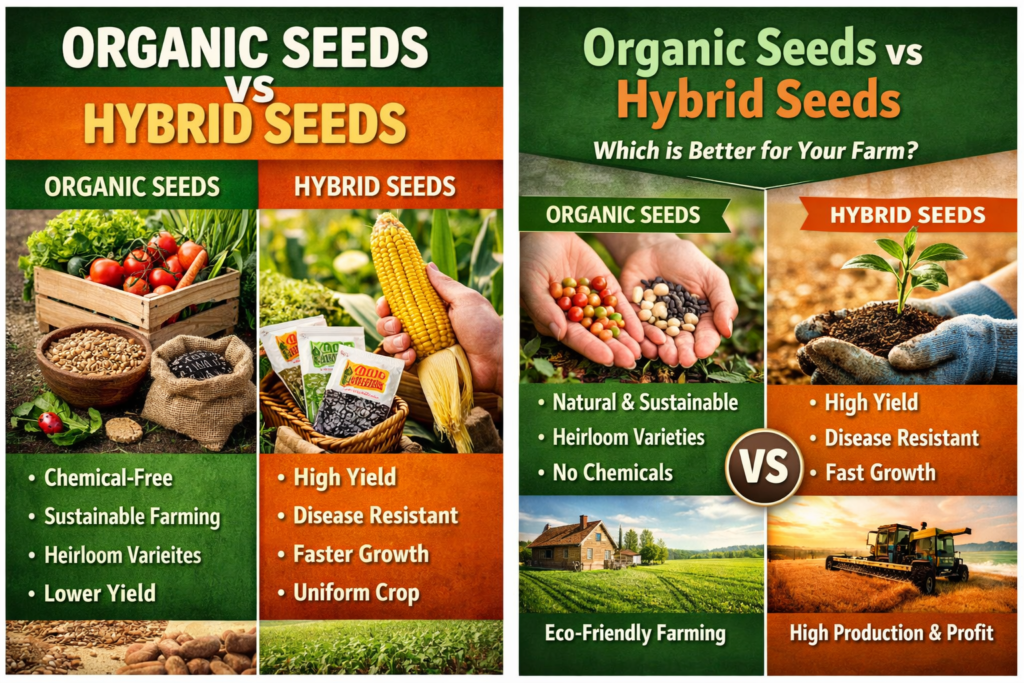
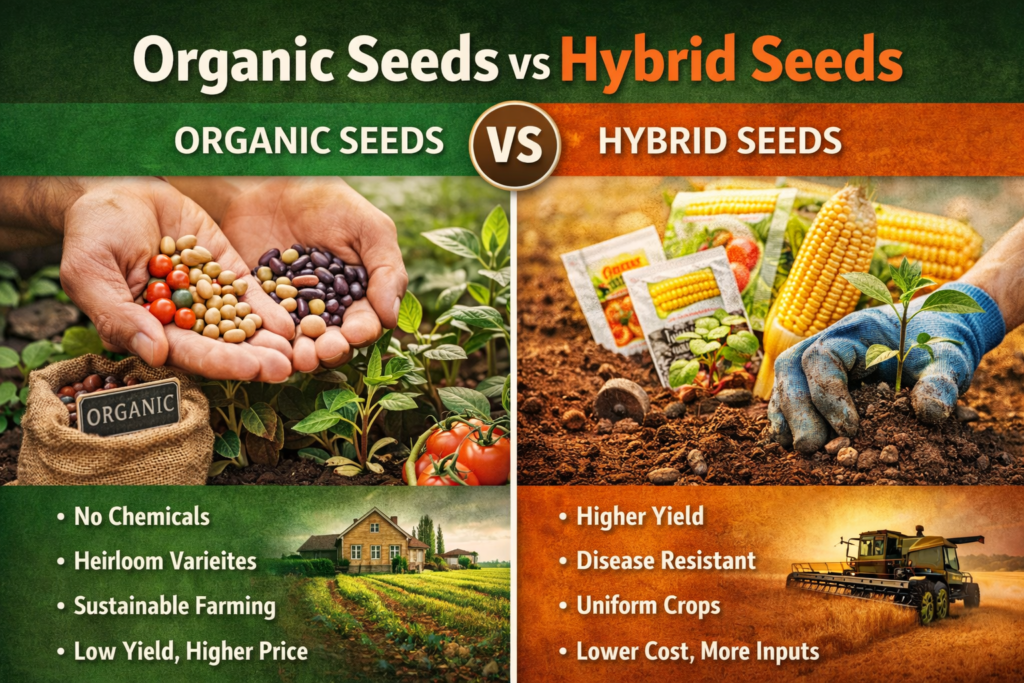
Organic seeds are ideal for sustainability, soil health, and premium market produce. Hybrid seeds offer higher yields, uniform crops, and faster growth. The choice depends on farm size, goals, and available resources.
Crop yield considerations are essential. Hybrid seeds are best when the priority is maximum production per acre. Organic seeds are preferred when long-term soil health, ecological balance, and premium pricing are goals.
Soil and Water Management
Organic seeds benefit from natural fertilizers, compost, and sustainable irrigation techniques. Hybrid seeds often require precision farming tools like automated irrigation systems, nutrient spreaders, and soil monitoring sensors to maintain optimal soil fertility.
Pest and Disease Management
Organic seeds rely on natural pest control, companion planting, and beneficial insects to manage threats. Hybrid seeds may tolerate certain diseases but typically need chemical pest control to achieve maximum yield.
Economic Perspective
Organic seeds can fetch higher market prices, but lower yields may reduce total revenue. Hybrid seeds offer higher production and faster harvests but increase input costs and dependency on chemicals. Farm goals, target markets, and resources will determine which seed type is more profitable.
When to Choose Organic Seeds
Organic seeds are ideal for small-scale farms aiming for premium markets. They suit operations practicing eco-friendly methods and farmers who want self-sufficient seed cycles. Access to organic fertilizers and natural pest control methods enhances performance.
When to Choose Hybrid Seeds
Hybrid seeds are suited for large-scale farms focused on maximum production. They perform well in areas with pest or disease pressure and farms using modern farming tools and automation. Hybrid seeds also enable faster and uniform harvests.
Tools That Enhance Seed Performance
Modern farming tools maximize seed performance. Seed drills ensure precise planting depth and spacing. Drip and sprinkler irrigation systems provide a consistent water supply. Soil testing kits determine nutrient needs, while fertilization spreaders deliver nutrients efficiently. Pest monitoring devices, drones, and harvesting equipment further improve yield and crop quality.
FAQs About Organic and Hybrid Seeds
Choosing the right seeds is one of the most important decisions in modern agriculture. Farmers often ask whether hybrid seeds can be used in organic farming, how yields compare between organic and hybrid seeds, and which option is more suitable for long-term sustainability. Understanding these questions helps improve productivity, reduce risks, and align farming practices with market demand.
Can hybrid seeds be used in organic farming?
Hybrid seeds generally cannot be used in certified organic farming systems. Organic farming standards require seeds that are produced without synthetic fertilizers, chemical pesticides, or genetically modified inputs. Most hybrid seeds are developed using conventional breeding systems that rely on chemical treatments and controlled environments, which do not meet organic certification rules.
In organic agriculture, seed purity and natural adaptability are critical. Organic seeds are selected for resilience in natural soil conditions and compatibility with organic inputs such as compost and bio-fertilizers. While hybrid seeds may perform well in conventional systems, they usually do not align with organic regulations or long-term ecological goals.
Do organic seeds yield less than hybrid seeds?
In many cases, organic seeds produce lower yields compared to hybrid seeds, especially in the short term. Hybrid seeds are specifically engineered for high productivity, uniform growth, and resistance to certain pests and diseases. This makes them popular in large-scale agriculture where maximum output per acre is the primary goal.
However, lower yield does not mean poor performance. With proper soil management, balanced nutrition, and effective irrigation tools, organic seeds can deliver stable and competitive yields over time. Practices such as crop rotation, compost application, and soil testing help improve nutrient availability and plant health. In long-term agriculture systems, organic seeds often contribute to healthier soil, which supports consistent production season after season.
Are hybrid seeds suitable for small farms?
Hybrid seeds can be suitable for small farms, but they come with higher input requirements. These seeds often demand precise irrigation, regular fertilization, and pest control to achieve expected results. For small-scale farmers with limited budgets, the cost of these inputs can be challenging.
That said, small farms focused on commercial production or fast crop turnover may benefit from hybrid seeds. Uniform growth, predictable harvest times, and higher yields can improve market supply and income. The key factor is resource availability. Farmers using hybrid seeds should have access to modern agriculture tools such as seed drills, irrigation systems, and pest monitoring devices to manage costs effectively.
Can hybrid seeds be replanted?
One major limitation of hybrid seeds is that they usually cannot be replanted. Seeds saved from hybrid crops rarely produce plants with the same traits in the next generation. This happens because hybrid vigor is lost after the first crop cycle.
As a result, farmers must purchase new hybrid seeds every season. This increases dependency on seed suppliers and raises long-term costs. Organic seeds, on the other hand, can often be saved and replanted while maintaining stable characteristics. This makes them more suitable for self-sufficient and low-input agriculture systems.
Which seed type is better for sustainable farming?
From a sustainability perspective, organic seeds are generally the better choice. They support soil health, encourage biodiversity, and reduce dependence on synthetic chemicals. Over time, organic seed systems improve soil structure, enhance microbial activity, and reduce environmental impact.
Hybrid seeds can contribute to short-term efficiency, but heavy reliance on chemical inputs may degrade soil quality if not managed carefully. Sustainable agriculture aims to balance productivity with environmental protection, and organic seeds align more closely with these goals.
What tools help improve seed performance?
Regardless of seed type, modern farming tools play a vital role in improving performance. Seed drills ensure proper spacing and planting depth, which supports uniform germination. Irrigation systems such as drip or sprinkler setups provide consistent water supply, reducing stress on crops.
Soil testers help identify nutrient deficiencies and guide fertilisation strategies. Fertilisation spreaders ensure accurate nutrient distribution, while pest monitoring devices and traps reduce crop damage. These agriculture tools help both organic and hybrid seeds reach their full potential.
Conclusion: Choosing the Right Seeds for Your Farm
The choice between organic and hybrid seeds depends on farm goals, available resources, and market strategy. Organic seeds are ideal for sustainable agriculture, premium produce markets, and long-term soil health. Hybrid seeds are better suited for maximising yield, achieving uniform crops, and faster harvest cycles.
When combined with the right agriculture tools—such as seed drills, precision irrigation systems, and soil monitoring devices—both seed types can deliver strong results. Understanding the strengths and limitations of organic and hybrid seeds allows farmers to make informed decisions that improve productivity, profitability, and sustainability.